In August 2017, the N05A gas field was discovered in the Dutch–German North Sea, north of Schiermonnikoog. The N05A platform, responsible for gas treatment, became a first for the Netherlands: a production platform powered entirely by wind energy from the nearby Riffgat wind farm, enabling gas production with minimal operational emissions. The facility was developed around an NNMI (Not Normally Manned Installation) concept and an APL (Autonomous Production Location) gas/condensate production process, setting a high bar for reliability, integrity, and predictable performance.
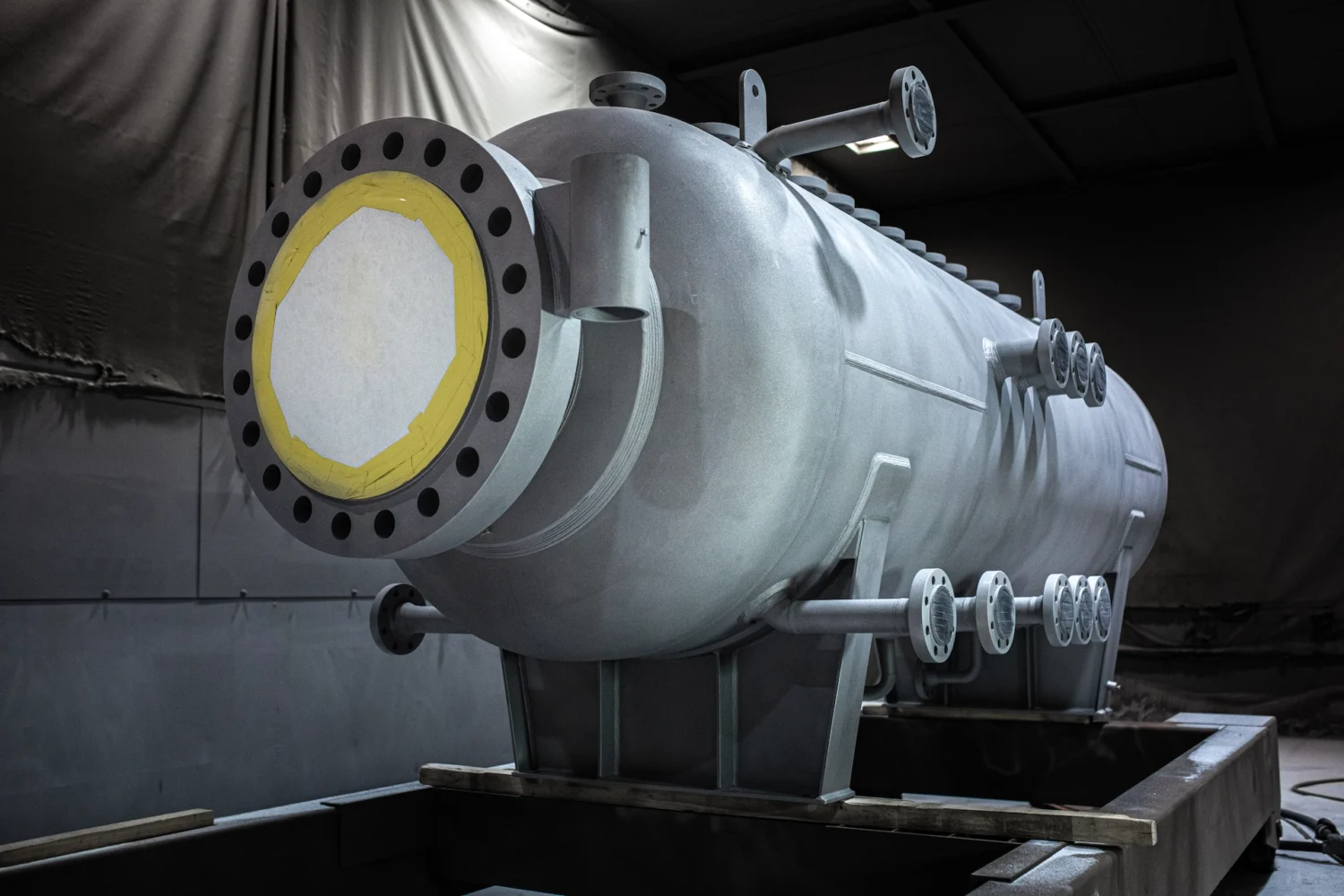
Titan contributed to this platform by engineering and manufacturing four high-pressure process vessels: the production separators, inlet scrubber, and flash vessel. Designed for a maximum operating pressure of 111 bar(g) and a design temperature range of –20 to 100 °C, these vessels sit at the heart of safe, stable offshore processing, where equipment availability and integrity are non-negotiable.
All engineering was executed in-house by Titan in accordance with PED 2014/68/EU and EN 13445, aligned with the client’s specifications and generally accepted offshore standards. From the outset, the focus was not only on meeting code requirements, but on building a complete, auditable compliance chain from design decisions through manufacturing controls and final certification.
Given the offshore environment and the duty profile of the vessels, duplex stainless steel was selected and procured under strict requirements. Materials were sourced with West-European origin and supplied with certification to EN 10204 3.2. To protect traceability and prevent material risk from entering the build process, Titan implemented a dedicated incoming goods control regime, with PMI (Positive Material Identification) embedded as a standard verification step. Only after verification were materials released to production, ensuring full traceability throughout fabrication.
Manufacturing was executed in close cooperation with the client, the client’s inspection body, and the Notified Body Bureau Veritas, under Module G. This collaboration created short evaluation cycles and fast decision-making when questions arose. Important on projects where schedule pressure and offshore requirements meet. Before the hydraulic test, all internals were installed in cooperation with the client, ensuring correct fit-up. This approach also gave the client practical familiarity with disassembly steps for future maintenance.
The vessels were then hydrostatically tested in-house at 160 bar(g). Following a thorough inspection by the client, the vessels were released for installation and ultimately mounted on the platform delivering qualified, traceable, high-pressure equipment that supports a modern, wind-powered offshore production concept.